
The Complete Guide to Open-Ended Play: What It Is, Why It Works, and How to Start
Hand a young child an expensive toy and a cardboard box, and there is a fair chance they choose the box. More than an insider joke among parents, It is a clue about how children actually learn, and it is the whole idea behind open-ended play. This guide explains what open-ended play is, what the research says about why it matters, how to recognize a truly open-ended toy, and how to make more of it happen at home, stage by stage.
What is open-ended play?
Open-ended play is play with no set rules, no instructions, and no single correct outcome. The child decides what the object is, what the story is, and how long it lasts. A block becomes a phone, then a car, then a slice of toast. A scarf becomes a cape, then a river, then a blanket for a doll. It is the opposite of closed-ended play, where a toy has one job and one solution, like a shape sorter or a puzzle.
Both kinds of play have value. Closed-ended toys teach a specific skill with a clear finish. Open-ended toys hand the child the pencil and let them write the whole story, which is where imagination, language, and problem-solving grow. It helps to think of it as a spectrum from closed to open, and to notice that the most open materials tend to hold a child's attention the longest.
| Closed-ended toy | Open-ended toy | |
|---|---|---|
| Ways to play | Usually one, with a "right" answer | Many, with no wrong way, tend to be very "simple" |
| Who leads | The toy sets the task | The child dictates what they do with the toy |
| Staying power | Interest fades once it is solved | Grows and changes with the child for years |
| Examples | Shape sorter, puzzle, most battery toys | Balls, blocks, play silks, boxes, cups, loose parts |
What does the research say about open-ended play?
The case for this kind of play is stronger than most parents realize, and it comes from reputable sources.
The American Academy of Pediatrics devotes an entire clinical report, The Power of Play, to the subject, and defines play as activity that is intrinsically motivated, actively engaging, and leads to joyful discovery. The report, led by Michael Yogman, MD, of Harvard Medical School and reaffirmed in 2025, describes unstructured play as far from frivolous, calling it a driver of healthy brain development that helps build executive function, the planning and self-regulation skills a child draws on for the rest of their life. Read the AAP report here.
Open-ended play is where a lot of that development happens, because the child is doing the deciding. When a toddler assigns meaning to an object, choosing that a ball is a moon, they are practicing symbolic thinking. When they narrate what they are doing, they are building language. When they set and solve their own small challenges, they are practicing problem-solving and focus without an adult directing the next step.
There is also a simple, decades-old idea about materials that explains why some toys spark far more of this than others.
In 1971, architect Simon Nicholson proposed the Theory of Loose Parts, the foundation much of today's thinking about open-ended materials rests on. His core observation was that the more varied and open the materials in a space, the more inventive and creative children's play becomes. Loose parts are simply objects a child can move, combine, and repurpose freely, with no fixed instructions. More on loose parts here.
That is the reason a stick can beat a slide. A slide does one thing. A stick becomes a fishing pole, a spoon, a wand, or a sword, so it invites the child to keep inventing. The most open-ended toys are the ones with the most possibilities packed into the simplest form.
What makes a great open-ended toy?
Using the loose-parts idea, a good open-ended toy tends to share four traits:
- It can be used in many different ways.
- It has no single correct outcome.
- It grows with the child rather than being quickly outgrown.
- It invites the child, not the toy, to lead the play.
Balls, blocks, cloths, cups, boxes, and safe household loose parts all pass that test. And perhaps most importantly, the way a child uses them changes as the child grows. Here are a few examples of what that can look like in practice.
A ball. One of the oldest and most open-ended play objects there is. A baby may grasp, mouth, squeeze, and roll it. A toddler may throw, chase, hide, or stack it. Later, that same ball can become part of a game, a character, a planet, an ingredient in pretend soup, or almost anything else a child imagines.
Our b is for ball® was designed around that same idea, but with even more possibilities built into one simple object. It can do all the things you expect from a ball, roll, bounce, stack, hide, toss, and inspire pretend play, but it also opens into two pieces for scooping, pouring, filling, and water play. It can squirt in the bath, become a little container or cup during pretend play, and then open completely so every surface can be washed, dried, and cleaned. Instead of assigning one way to play, its different physical properties give children more things to discover and more ways to reinvent it over time.
Shop Our Best-Selling b is for ball®
Shop the full collection →


The box. The child who plays with the box instead of the toy is following the loose-parts instinct precisely, because an empty box often offers more possibilities than a single-purpose toy. What makes a box especially interesting is that children see different possibilities in it as they grow.
For a baby, a box can be a place where something disappears and comes back again, an early lesson in object permanence. A toddler may fill it, empty it, carry things inside it, stack it, or climb into a larger one. A preschooler might turn that same box into a car, house, oven, robot, store, bed for a stuffed animal, or part of a much larger construction. The object stays simple; the child's thinking becomes increasingly complex.
That is why we treat packaging as part of the play rather than something to recycle on day one. Our Montessori-inspired box folds into a ball-drop game, can be explored as an object-permanence box, and later becomes storage, a building block, or whatever else a child decides it should be.
✨ Our pick: a set where the box is part of the play
Three b is for ball® arrive in a train toy box that is part of the play, not packaging to toss. Each food-grade silicone ball opens into two halves and works as a teether, a scoop, and an open-ended toy, while the box becomes a ball drop, a garage, and storage.

3-Ball Silicone Baby Sensory Set – "Choo Choo" Train Toy Box
$45.00 · Dishwasher, sterilizer & freezer safe
A play silk. A single square of cloth may be one of the purest loose parts of all, because its shape gives almost nothing away about what it is "supposed" to be.
For a baby, fabric can be something to touch, grasp, wave, watch move, or use for a simple game of peekaboo. A toddler might hide objects underneath it, carry toys in it, tuck in a doll, or wear it around their shoulders. A preschooler sees a cape, skirt, river, picnic blanket, ocean, fort roof, dance ribbon, or landscape for small-world play. As children get older, it can become part of more elaborate costumes, performances, forts, games, and imagined worlds.
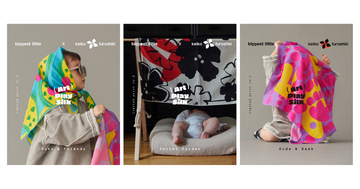
Our Art Play Silk adds original artwork to that blank canvas without deciding what the cloth should become. The illustrations offer another place for imagination to begin, while the child still gets to decide where the story goes.
Blocks. Blocks are a classic example of open-ended play because there is no finished picture to copy and no single way to succeed. A baby may simply hold two blocks, feel their weight, bang them together, or watch one fall. A toddler discovers stacking, knocking down, balancing, lining up, and carrying. A preschooler begins building houses, roads, towers, zoos, spaceships, and entire imaginary worlds. Older children can use the same basic shapes to experiment with symmetry, stability, engineering, patterns, and increasingly elaborate structures.
The blocks themselves have hardly changed. What changes is the child: their motor skills, imagination, planning, storytelling, and understanding of the physical world.
The point is not any particular toy. It is the openness of the object. A good open-ended material leaves room between what the object is and what the child can imagine it could be. And you almost certainly already own a few of the best examples, sitting in a kitchen drawer, a linen closet, or the recycling bin.
How to encourage open-ended play at home
You do not need a playroom or a shopping list. A few small shifts do most of the work.
-
Offer fewer toys, and rotate them
Put most of the toys away and bring out a small selection, then swap them every couple of weeks. Fewer choices tend to lead to longer, deeper play, and everything feels fresh again when it reappears.
-
Keep a few open materials within reach
A basket of loose parts, balls, cloths, cups, blocks, and safe household objects, on a low shelf lets your child start and end play on their own, which builds independence.
-
Protect unstructured time, and follow the lead
Open-ended play needs room to unfold, so resist filling every hour. When your child uses a toy in an unexpected way, that is the play working, not a mistake to correct. Let them decide where the story goes.
Those are the foundations. For a fuller set of specific activities you can try today, see our companion guide on integrating open-ended play at home.
Open-ended play by age
Open-ended play looks different at every stage, and the best materials grow with the child instead of getting outgrown.
0 to 6 months
Play is sensory. Babies watch, grasp, mouth, and track movement. Offer high-contrast objects, a soft cloth that moves in the air, and a graspable ball to hold and explore. A silk drifting overhead or a ball rolling slowly are early cause-and-effect lessons.
6 to 12 months
Mouthing and container play take over. Babies love putting things in and taking them out, and games of peekaboo. A ball that opens, a cup to fill, a box to empty, and a cloth to hide and reveal are endlessly interesting now.
1 to 2 years
Stacking, nesting, filling, and dumping, with simple pretend beginning. A few balls to stack and carry, and a box that becomes a container or a drum, support this without any single right way to play.
2 to 3 years
Symbolic play blooms. A box becomes a car, a silk becomes a cape, a corner becomes a shop. Give open props and narrate along as their stories grow longer and more detailed.
3 to 5 years
Elaborate, self-directed worlds with invented rules, forts, characters, and long story arcs. The same ball, box, and silks from infancy now become goalposts, building materials, and costumes. Fewer, better pieces carry all the way here.
A note on the mindset
You do not need a shelf of special toys to raise a creative child. Often the opposite helps more. Our founder learned this in her own overflowing living room, worn out by a floor full of toys her children fought over and quickly abandoned, and what she wanted was not another toy but an open-ended tool, which is the whole reason Biggest Little exists. If that shift in thinking speaks to you, the story of why we started and our perspective shift on open-ended play go deeper, as do our guides to minimalist parenting and what a cognitive-development professor observed watching one simple ball for five months.
SUMMARY
- Open-ended play is play with no fixed rules and no single right outcome, where the child decides what an object becomes and where the story goes.
- Pediatric research treats unstructured, child-led play as a driver of healthy brain development, not a break from learning.
- The best open-ended toys are simple and variable, which is why a ball, a box, and a square of cloth outlast most battery-powered toys.
- To start, offer fewer toys, keep a few open materials within reach, protect unstructured time, and follow your child's lead.
Frequently asked questions
What is open-ended play?
Open-ended play is unstructured, child-led play with no fixed rules and no single correct outcome. The child decides what an object is and what happens with it, so the same toy can be used many different ways.
What are examples of open-ended toys?
Balls, wooden blocks, play silks and fabric pieces, cups, and boxes, along with safe household loose parts. The common thread is that they have no predefined use, so a child can turn them into anything.
Why is open-ended play important?
Pediatric research links unstructured, child-led play to healthy brain development, including executive function, creativity, language, and self-regulation. Because the child leads, open-ended play is a rich setting for all of it.
What is the difference between open-ended play and Montessori play?
They overlap but are not the same. Montessori materials are often designed for a specific, self-correcting purpose, while open-ended play has no set outcome at all. Many open-ended toys, like a ball or a play silk, fit comfortably in a Montessori-inspired home.
At what age can open-ended play start?
From birth, in a sensory form. Newborns explore through looking, grasping, and mouthing, and open-ended materials like a simple ball or a soft cloth grow with the child through every stage that follows.